
Reading Problems: Rereading + Record Keeping
plus, the book's social function...part two in an ongoing series

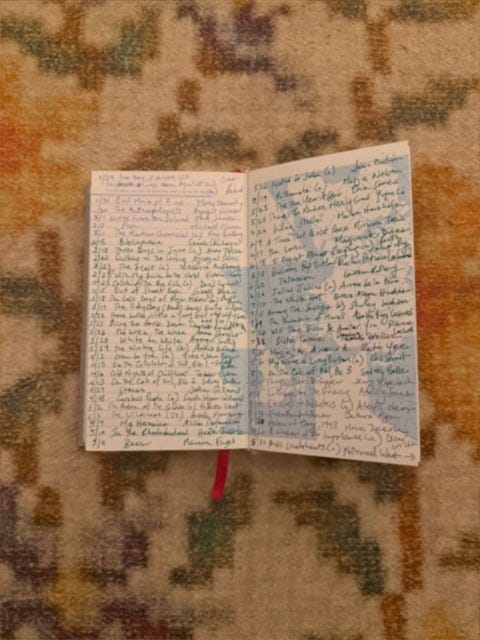
In my last post, I discussed some of my anxiety around remembering what I read. Undoubtedly, the books that I remember the best (as in, with the greatest clarity) are the ones that I either studied for a prolonged period (Walter Benjamin! James Joyce!), or those that I have read more than once (a bunch of Woolf, e.g.)—of course, there is overlap between these two categories. In my Retention post, I also talked about my childhood reading habits—reading books compulsively, over and over, almost to the point of memorization. At this point in my life, I like to think of reading as a kind of Ignatian exercise, and if I retroactively apply that framework to my life in books, it’s easy to see a kind of spiritual maturation: from the rote practices of childhood to the self-serious modes of adulthood to now, a period that feels rich, busy, difficult, rewarding, and a lot more stripped of ego. I know that I have a long way to go.
I have been thinking about my relationship with rereading in this era of “bookstore reading,” aka reading for work, and personal reading metrics, popularized by, I’m guessing, Goodreads. I don’t think I really knew that Goodreads existed until my book was coming out and I came across, time and again, the advice for authors, especially debut authors, to steer clear. I’ve gone on the site a few times but there’s nothing about it that appeals to me. I’m not terribly interested in reviews unless they are compellingly written, works of art in and of themselves that tussle with the material, meet the momentum of, and ultimately serve the conversation enacted by the work. Summaries and quick opinions won’t influence me to read or not read something.
As a subsidiary of Amazon, Goodreads can’t be separated from its mission to track and monetize, but neither can anything that happens on our phones or browsers. Every click feels (or is) tied to some nefariousness, and sometimes the best I can do is, I guess, be aware of that? There’s privilege involved in being able to opt out altogether. Even so, I enjoy persisting in the belief that the act of reading can remain as decommodified as we allow it to be (hello, libraries!). Rereading, especially rereading a book you already own, feels like a giant virtuous step away from the marketplace, and an antidote to the strain of hustle culture that has infected the life of the mind.
I guess on some level I chafe at reading-made-social, this mightiest and most hallowed way to be alone. I get nervous before every single book club, because what do you mean I have to share the feelings I might not have words for yet, or listen to someone’s slanderous take, or navigate discussions of relatability, unlikeable characters, or value judgments? And yet, in moments, such togetherness can be transcendent. True connection, true engagement, true expansion. Folding chairs and cleaning up at Thank You Books after a really satisfying book club, I have thought to myself, we did it. We grew a community from this most solitary joy. A Public Space is another exquisite model of alone-together—I highly recommend to anyone who’s book club-averse, or misses “homework,” or wants an expertly guided reading experience, or all of the above. The same two wolves, I think, exist in many of us: we love submitting to the solitude of reading. And we also love talking about books.
Book-related social media has proliferated the idea of “reading goals,” benign enough on its face, but intrinsically tied to quantity. When I was in school, reading goals were not called reading goals—they were called syllabi, curricula. Depth was generally valued over breadth; deadlines were imposed by the professor. A recursiveness existed naturally because written work was expected, too. This experience—of reading a text, and then reading it with an eye for how to write about it, the zooming in and out, mining for quotes and references, theorizing and extracting—widens the corridor of the reading process. My reading log may reflect that I read one (1) book, but I read it with a surfeit of attention.
I don’t mean to suggest that all people who care about reading care overmuch about “numbers.” But based on anecdotal evidence, I think many do. I think it comes down to a feeling of wanting to “have something to show” for this basically invisible activity, a way of planting a flag in, for example, a year. “In 2025 I read x number of books, ran x number of miles, and visited x number of cities.” We want a record of our accomplishments, and increasingly, there is a widespread understanding of reading as an accomplishment. I’m all for it!
At least, I think I am. I guess I’m grappling with this relatively new territory of doing for my job—and to be clear, this means reading with an eye toward selling, among other factors—what I’ve always done for my sanity, survival, and pleasure. Reading is not as it was. It’s not better or worse, but it’s different. It used to be unbound by any metric, free from any value system that may have applied to the rest of my life. Now it’s not. My time, split as it is between work, and my family, and my haphazard attempts to work on a novel, must be measured and distributed appropriately. Like the laundry and bills, the books keep coming, and while I’ll never be able to read them all (gross understatement), I do need to read as many as I can. “Rebelling” means reading a book from 1982 for the thrill of it. And the thrill of it still matters, because it makes the rest of it possible.
So I wonder: for people who aren’t in any way connected to the book industry—what is gained by the sort of “competitive reading” that I’ve gotten glimpses of, in the shop and online, and what is lost? Is a really ramped up reading life a mode of contesting despair, or another form of stress that invites it? Is everyone okay?
Every year around this time, for the past handful of years, I have this vague idea that I’ll do reading differently next year, which seems suspiciously like a reading goal, something I’ve already suggested I feel squeamish about. Go more slowly, make more notes, memorize a few poems. And every year I get swept up in the year’s own particular energy—more vibes than method. This year I reread (or reread via audiobook) a few books: Lincoln in the Bardo, Of Mice and Men, The Martian Chronicles, The Writing Life, The Lover (for the third time), and Stoner. Lincoln and Mice because I wanted to hear them performed; Martian for sci-fi book club, Dillard because I thought it might be a shot in the arm (it wasn’t), Duras with APS, and Stoner because I dared myself to do it for book club and had to see it through. The Lover was more devastating this time around than it had ever been, and I surprised myself by enjoying Stoner more than I had the first time, an enjoyment devoid of archness. I mentioned in my last post that a book can be a photograph or a diary; add to that how it can also be a Rorschach test. The book doesn’t change, but we do.
Currently reading:
Bleak House with A Public Space
Orbital by Samantha Harvey

